Report
The Missing Metric in Senior
Living: Resident Autonomy
By Zoe Goldman
Senior living often says it exists to preserve independence. But the industry measures safety far more precisely than autonomy.
We track falls, incidents, response times, care tasks, medications, documentation, and staffing. Those metrics matter. Falls alone remain one of the biggest risks in aging: the CDC reports that more than 14 million adults 65 and older, about 1 in 4, fall each year; 37% of those who fall report an injury requiring medical treatment or at least one day of restricted activity.
But safety is not the same as independence. A resident can be safe and still be losing control over daily life. They can receive every scheduled service and still have fewer choices than they had a month ago. They can be protected from risk, but also from movement, usefulness, privacy, and self-direction.
That is the autonomy paradox in senior living: in the name of protecting residents, care systems can quietly make residents’ worlds smaller.
Report
The Missing Metric in Senior
Living: Resident Autonomy
By Zoe Goldman
Senior living often says it exists to preserve independence. But the industry measures safety far more precisely than autonomy.
We track falls, incidents, response times, care tasks, medications, documentation, and staffing. Those metrics matter. Falls alone remain one of the biggest risks in aging: the CDC reports that more than 14 million adults 65 and older, about 1 in 4, fall each year; 37% of those who fall report an injury requiring medical treatment or at least one day of restricted activity.
But safety is not the same as independence. A resident can be safe and still be losing control over daily life. They can receive every scheduled service and still have fewer choices than they had a month ago. They can be protected from risk, but also from movement, usefulness, privacy, and self-direction.
That is the autonomy paradox in senior living: in the name of protecting residents, care systems can quietly make residents’ worlds smaller.
The Missing Metric in Senior
Living: Resident Autonomy
By Zoe Goldman
Senior living often says it exists to preserve independence. But the industry measures safety far more precisely than autonomy.
We track falls, incidents, response times, care tasks, medications, documentation, and staffing. Those metrics matter. Falls alone remain one of the biggest risks in aging: the CDC reports that more than 14 million adults 65 and older, about 1 in 4, fall each year; 37% of those who fall report an injury requiring medical treatment or at least one day of restricted activity.
But safety is not the same as independence. A resident can be safe and still be losing control over daily life. They can receive every scheduled service and still have fewer choices than they had a month ago. They can be protected from risk, but also from movement, usefulness, privacy, and self-direction.
That is the autonomy paradox in senior living: in the name of protecting residents, care systems can quietly make residents’ worlds smaller.
Autonomy is a Health Variable
The link between autonomy and well-being is not new. In a classic field experiment, Ellen Langer and Judith Rodin gave one group of nursing home residents more choice and responsibility over daily life: arranging their rooms, choosing activities, deciding when to watch a movie, and caring for a plant. A comparison group received a positive message too, but staff retained more responsibility for residents’ daily experience. After three weeks, the residents with more responsibility were rated as happier, more active, more alert, and more sociable. At 18 months, the difference was even more striking: the group given more choice and responsibility had half the mortality rate of the comparison group, 15% versus 30%.
That finding raises a question senior living should take seriously: is the goal simply to help residents live longer, or to help them live better for as long as possible?
The intervention was not clinical. It did not require a new medication, device, or staffing model. It changed how much control residents had over ordinary life. And its effects seemed to touch both dimensions of aging that matter most: quality of life and, potentially, longevity.
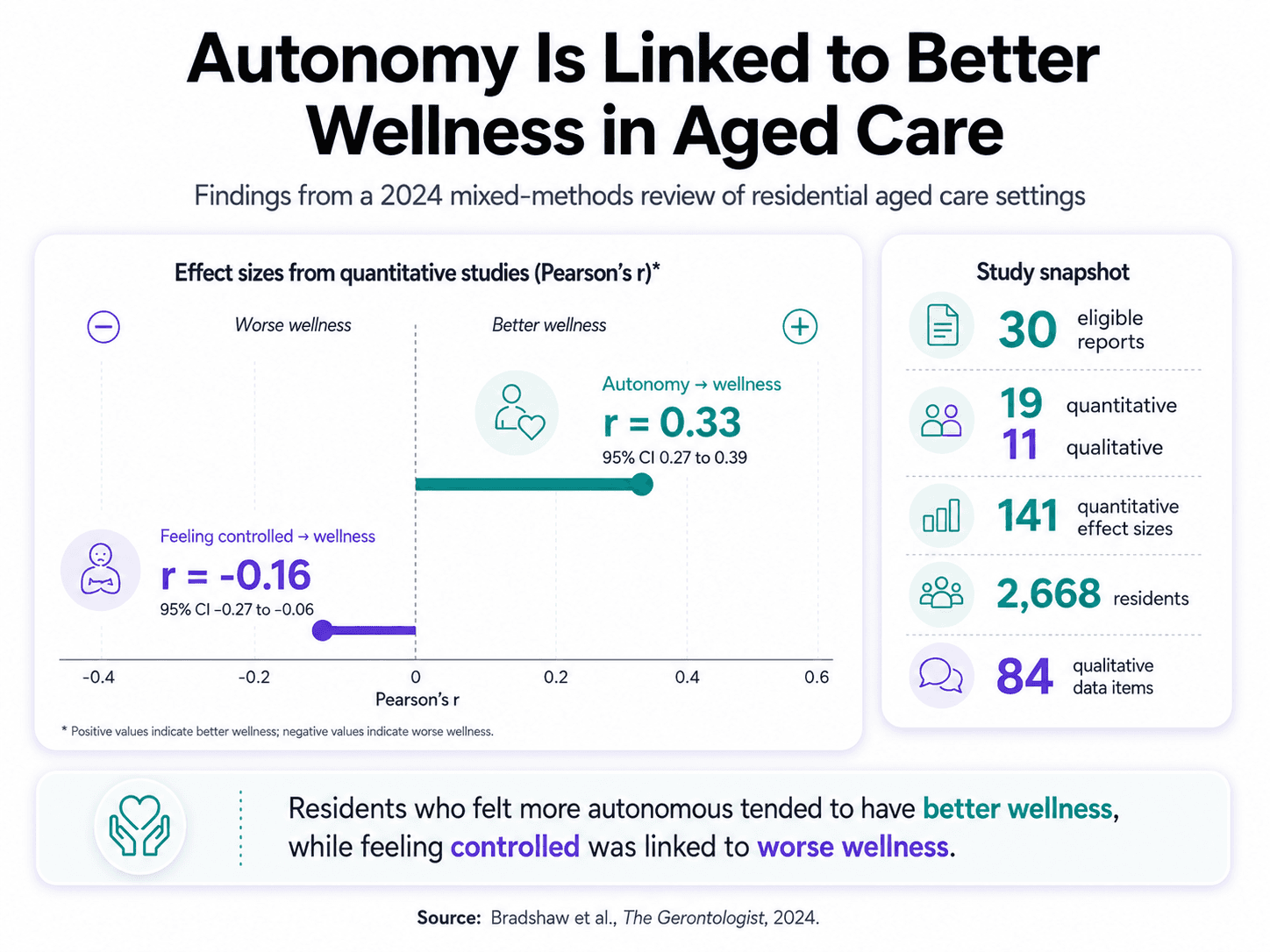
More recent research points in the same direction. A 2024 mixed-methods review of aged care settings analyzed 30 reports, 141 quantitative effect sizes, and 2,668 residents. It found that residents’ autonomy was positively associated with wellness, while feeling controlled was negatively associated with wellness. The authors concluded that autonomy should be supported and unnecessary external control minimized in residential aged care.
That finding should make senior living uncomfortable in a useful way. Because in daily care, the fastest path is often the least autonomy-preserving one.
The Dependence Trap
In practice, autonomy often loses to throughput. Under staffing pressure, it is faster to complete a task than preserve the resident’s role in it: dressing instead of cueing, transporting instead of walking alongside, defaulting to the safest routine instead of making space for choice.
These decisions are usually rational in the moment, but over time they can turn support into substitution. The community may still be completing the care plan while quietly reducing the resident’s remaining capacity.
Safety and Autonomy Are Not Opposites
The goal is not to choose autonomy over safety; it’s to stop treating safety and autonomy as if they cannot coexist.
A 2025 article in The Gerontologist describes this as a central tension in aging, especially for older adults with cognitive impairment, complex health needs, or age-related vulnerability. The authors argue that safety and autonomy should be navigated together, not treated as a binary choice. When safety is prioritized at the expense of autonomy, protective measures can override preferences, erode agency, and reduce quality of life.
That tension shows up every day in senior living.
Should a resident walk to meals if they are a fall risk? Should they be allowed to make a choice the team sees as unwise? Should a routine be built around staff efficiency or resident preference? Should “help” mean doing the task, or preserving the resident’s ability to participate in it?
These are not abstract ethical questions. They are operational questions.
Autonomy is a Health Variable
The link between autonomy and well-being is not new. In a classic field experiment, Ellen Langer and Judith Rodin gave one group of nursing home residents more choice and responsibility over daily life: arranging their rooms, choosing activities, deciding when to watch a movie, and caring for a plant. A comparison group received a positive message too, but staff retained more responsibility for residents’ daily experience. After three weeks, the residents with more responsibility were rated as happier, more active, more alert, and more sociable. At 18 months, the difference was even more striking: the group given more choice and responsibility had half the mortality rate of the comparison group, 15% versus 30%.
That finding raises a question senior living should take seriously: is the goal simply to help residents live longer, or to help them live better for as long as possible?
The intervention was not clinical. It did not require a new medication, device, or staffing model. It changed how much control residents had over ordinary life. And its effects seemed to touch both dimensions of aging that matter most: quality of life and, potentially, longevity.
Autonomy is a Health Variable
The link between autonomy and well-being is not new. In a classic field experiment, Ellen Langer and Judith Rodin gave one group of nursing home residents more choice and responsibility over daily life: arranging their rooms, choosing activities, deciding when to watch a movie, and caring for a plant. A comparison group received a positive message too, but staff retained more responsibility for residents’ daily experience. After three weeks, the residents with more responsibility were rated as happier, more active, more alert, and more sociable. At 18 months, the difference was even more striking: the group given more choice and responsibility had half the mortality rate of the comparison group, 15% versus 30%.
That finding raises a question senior living should take seriously: is the goal simply to help residents live longer, or to help them live better for as long as possible?
The intervention was not clinical. It did not require a new medication, device, or staffing model. It changed how much control residents had over ordinary life. And its effects seemed to touch both dimensions of aging that matter most: quality of life and, potentially, longevity.
More recent research points in the same direction. A 2024 mixed-methods review of aged care settings analyzed 30 reports, 141 quantitative effect sizes, and 2,668 residents. It found that residents’ autonomy was positively associated with wellness, while feeling controlled was negatively associated with wellness. The authors concluded that autonomy should be supported and unnecessary external control minimized in residential aged care.
That finding should make senior living uncomfortable in a useful way. Because in daily care, the fastest path is often the least autonomy-preserving one.
The Dependence Trap
In practice, autonomy often loses to throughput. Under staffing pressure, it is faster to complete a task than preserve the resident’s role in it: dressing instead of cueing, transporting instead of walking alongside, defaulting to the safest routine instead of making space for choice.
These decisions are usually rational in the moment, but over time they can turn support into substitution. The community may still be completing the care plan while quietly reducing the resident’s remaining capacity.
Safety and Autonomy Are Not Opposites
The goal is not to choose autonomy over safety; it’s to stop treating safety and autonomy as if they cannot coexist.
A 2025 article in The Gerontologist describes this as a central tension in aging, especially for older adults with cognitive impairment, complex health needs, or age-related vulnerability. The authors argue that safety and autonomy should be navigated together, not treated as a binary choice. When safety is prioritized at the expense of autonomy, protective measures can override preferences, erode agency, and reduce quality of life.
That tension shows up every day in senior living.
Should a resident walk to meals if they are a fall risk? Should they be allowed to make a choice the team sees as unwise? Should a routine be built around staff efficiency or resident preference? Should “help” mean doing the task, or preserving the resident’s ability to participate in it?
These are not abstract ethical questions. They are operational questions.
More recent research points in the same direction. A 2024 mixed-methods review of aged care settings analyzed 30 reports, 141 quantitative effect sizes, and 2,668 residents. It found that residents’ autonomy was positively associated with wellness, while feeling controlled was negatively associated with wellness. The authors concluded that autonomy should be supported and unnecessary external control minimized in residential aged care.
That finding should make senior living uncomfortable in a useful way. Because in daily care, the fastest path is often the least autonomy-preserving one.
The Dependence Trap
In practice, autonomy often loses to throughput. Under staffing pressure, it is faster to complete a task than preserve the resident’s role in it: dressing instead of cueing, transporting instead of walking alongside, defaulting to the safest routine instead of making space for choice.
These decisions are usually rational in the moment, but over time they can turn support into substitution. The community may still be completing the care plan while quietly reducing the resident’s remaining capacity.
Safety and Autonomy Are Not Opposites
The goal is not to choose autonomy over safety; it’s to stop treating safety and autonomy as if they cannot coexist.
A 2025 article in The Gerontologist describes this as a central tension in aging, especially for older adults with cognitive impairment, complex health needs, or age-related vulnerability. The authors argue that safety and autonomy should be navigated together, not treated as a binary choice. When safety is prioritized at the expense of autonomy, protective measures can override preferences, erode agency, and reduce quality of life.
That tension shows up every day in senior living.
Should a resident walk to meals if they are a fall risk? Should they be allowed to make a choice the team sees as unwise? Should a routine be built around staff efficiency or resident preference? Should “help” mean doing the task, or preserving the resident’s ability to participate in it?
These are not abstract ethical questions. They are operational questions.
The Missing Metric
Senior living has many ways to measure whether care happened, but it has fewer ways to measure whether the resident remained an active participant in that care.
That is the missing metric: resident autonomy.
Autonomy does not mean every resident is fully independent. Many residents need significant support. Some have cognitive impairment. Some cannot safely make every decision alone. But almost every resident can still express preferences, make choices, participate in routines, attempt abilities, or maintain some control over daily life.
A community serious about autonomy would ask:
What can this resident still do with cueing, not full assistance?
Where are we stepping in because help is needed, and where are we stepping in because it is faster?
Which restrictions are temporary, and which have become permanent by default?
Is this resident’s world getting larger or smaller?
Technology should help answer those questions, specifically by making the right signals easier to capture: changes in mobility, participation, preferences, routines, confidence, and the level of support a resident actually needs over time.
The future of senior living technology should not just be better monitoring. It should be better support for resident agency. Safety will always be foundational, but it cannot be the ceiling.
The best communities will be the ones that know how to support risk thoughtfully, preserve capability where possible, and notice when care is becoming substitution.
Senior living should measure more than whether residents are safe. It should measure whether they are still authors of their own lives.
Senior living has many ways to measure whether care happened, but it has fewer ways to measure whether the resident remained an active participant in that care.
That is the missing metric: resident autonomy.
Autonomy does not mean every resident is fully independent. Many residents need significant support. Some have cognitive impairment. Some cannot safely make every decision alone. But almost every resident can still express preferences, make choices, participate in routines, attempt abilities, or maintain some control over daily life.
A community serious about autonomy would ask:
What can this resident still do with cueing, not full assistance?
Where are we stepping in because help is needed, and where are we stepping in because it is faster?
Which restrictions are temporary, and which have become permanent by default?
Is this resident’s world getting larger or smaller?
Technology should help answer those questions, specifically by making the right signals easier to capture: changes in mobility, participation, preferences, routines, confidence, and the level of support a resident actually needs over time.
The future of senior living technology should not just be better monitoring. It should be better support for resident autonomy. Safety will always be foundational, but it cannot be the ceiling.
The best communities will be the ones that know how to support risk thoughtfully, preserve capability where possible, and notice when care is becoming substitution.
Senior living should measure more than whether residents are safe. It should measure whether they are still authors of their own lives.
Senior living has many ways to measure whether care happened, but it has fewer ways to measure whether the resident remained an active participant in that care.
That is the missing metric: resident autonomy.
Autonomy does not mean every resident is fully independent. Many residents need significant support. Some have cognitive impairment. Some cannot safely make every decision alone. But almost every resident can still express preferences, make choices, participate in routines, attempt abilities, or maintain some control over daily life.
A community serious about autonomy would ask:
What can this resident still do with cueing, not full assistance?
Where are we stepping in because help is needed, and where are we stepping in because it is faster?
Which restrictions are temporary, and which have become permanent by default?
Is this resident’s world getting larger or smaller?
Technology should help answer those questions, specifically by making the right signals easier to capture: changes in mobility, participation, preferences, routines, confidence, and the level of support a resident actually needs over time.
The future of senior living technology should not just be better monitoring. It should be better support for resident autonomy. Safety will always be foundational, but it cannot be the ceiling.
The best communities will be the ones that know how to support risk thoughtfully, preserve capability where possible, and notice when care is becoming substitution.
Senior living should measure more than whether residents are safe. It should measure whether they are still authors of their own lives.