Report
What Senior Living Can Learn from Healthcare’s Operating System of Visibility
By Zoe Goldman
What hospitals learned the hard way, and what senior living can adapt for residential care.
Senior living has more software than ever, but that does not automatically translate to better coordination or safer care. Hospitals have spent the last decade building an operating system of visibility: shared situational awareness, clear escalation pathways, and standardized handoffs that survive shifts, interruptions, and staffing changes.
Senior living can borrow from that playbook, but it should not copy it blindly. A senior living community is not a hospital. The goal is not patient throughput; it is calmer, clearer, more coordinated support for the residents who live there.
Below are two healthcare practices senior living can learn from.
Report
What Senior Living Can Learn from Healthcare’s Operating System of Visibility
By Zoe Goldman
What hospitals learned the hard way, and what senior living can adapt for residential care.
Senior living has more software than ever, but that does not automatically translate to better coordination or safer care. Hospitals have spent the last decade building an operating system of visibility: shared situational awareness, clear escalation pathways, and standardized handoffs that survive shifts, interruptions, and staffing changes.
Senior living can borrow from that playbook, but it should not copy it blindly. A senior living community is not a hospital. The goal is not patient throughput; it is calmer, clearer, more coordinated support for the residents who live there.
Below are two healthcare practices senior living can learn from.
What Senior Living Can Learn from Healthcare’s Operating System of Visibility
By Zoe Goldman
What hospitals learned the hard way, and what senior living can adapt for residential care.
Senior living has more software than ever, but that does not automatically translate to better coordination or safer care. Hospitals have spent the last decade building an operating system of visibility: shared situational awareness, clear escalation pathways, and standardized handoffs that survive shifts, interruptions, and staffing changes.
Senior living can borrow from that playbook, but it should not copy it blindly. A senior living community is not a hospital. The goal is not patient throughput; it is calmer, clearer, more coordinated support for the residents who live there.
Below are two healthcare practices senior living can learn from.
1) Shared, real-time situational awareness
Hospitals learned that binders, scattered notes, and person-to-person updates do not scale when care is fast-moving and cross-functional. Many emergency departments replaced manual dry-erase boards with electronic whiteboards because teams needed one shared picture of what was happening in real time. A systematic review of electronic whiteboards in emergency medicine found that they can influence ED work practices and information accuracy, while also emphasizing that outcomes depend on display design, workflow fit, and integration with other clinical IT systems.
At the enterprise level, many hospitals have gone further and built capacity command centers: colocated teams that use real-time data to manage patient flow across beds, transfers, and throughput. The Joint Commission Journal describes these command centers as an emerging response to safety and financial pressures created by ED boarding and constrained inpatient capacity, built around aggregated real-time data and cross-team coordination. In its benchmarking survey, 25 of 31 responding health systems were already operating a capacity command center; reducing ED boarding was the most common motivation, cited by 24 of those 25. The same survey found that 18 command centers tracked financial ROI, and all 18 reported positive ROI.
There is an important caution here: visibility tools only work when the surrounding workflow and data are solid. A status board is not a strategy. It works when it becomes the default place teams look, update, and act.
What senior living can borrow: one shared operational view for the shift, so teams can quickly see what changed, what needs action, and who owns it.
2) Structured huddles and handoffs that turn signals into action
Hospitals also learned that visibility without escalation just creates noise. One of the most transferable practices is the Tiered Huddle System: short, structured huddles where issues move from frontline teams to leadership with clear ownership and follow-through. “Tiered” means that concerns do not stay trapped at the level where they were first noticed. Frontline teams surface risks and blockers, department leaders resolve what they can, and unresolved or higher-risk issues move up to senior leaders with an owner and next step.
The impact can be significant. In one tiered huddle case study, patient safety reports increased from an average of 77 per month before implementation to 1,495 per month after implementation. A separate Joint Commission Journal study found that system-level tiered huddles led to a significant immediate increase in patient safety event reporting, including near misses and unsafe conditions.
This matters because many organizations already have plenty of signals. The problem is that signals do not always become action. A staff member notices a change. A nurse hears a concern. A family member mentions something in passing. A resident behaves differently than usual. Without a reliable escalation rhythm, those details can disappear into hallway conversations, shift changes, or informal memory.
That is why huddles and handoffs should be treated as one continuity system. Hospitals have also treated handoffs as a safety issue, not a communication preference. The most cited example is I-PASS, a structured handoff bundle that includes a mnemonic for oral and written sign-outs, training, observation, coaching, and sustainability mechanisms. Across nine pediatric residency programs, implementation of the I-PASS bundle was associated with a 23% relative reduction in preventable adverse events.
Senior living does not need to copy I-PASS exactly, but it can borrow the principle: handoffs should have a repeatable structure, not depend on whoever happens to be giving the update. In many communities, the daily standup, shift change, care coordination discussion, and “who needs extra eyes today?” conversation are already solving the same problem: making sure the right people know what changed, what matters, and what happens next.
What senior living can borrow: a short, repeatable operating rhythm for surfacing changes, escalating risks, assigning owners, and protecting continuity across shifts.
1) Shared, real-time situational awareness
Hospitals learned that binders, scattered notes, and person-to-person updates do not scale when care is fast-moving and cross-functional. Many emergency departments replaced manual dry-erase boards with electronic whiteboards because teams needed one shared picture of what was happening in real time. A systematic review of electronic whiteboards in emergency medicine found that they can influence ED work practices and information accuracy, while also emphasizing that outcomes depend on display design, workflow fit, and integration with other clinical IT systems.
At the enterprise level, many hospitals have gone further and built capacity command centers: colocated teams that use real-time data to manage patient flow across beds, transfers, and throughput. The Joint Commission Journal describes these command centers as an emerging response to safety and financial pressures created by ED boarding and constrained inpatient capacity, built around aggregated real-time data and cross-team coordination. In its benchmarking survey, 25 of 31 responding health systems were already operating a capacity command center; reducing ED boarding was the most common motivation, cited by 24 of those 25. The same survey found that 18 command centers tracked financial ROI, and all 18 reported positive ROI.
There is an important caution here: visibility tools only work when the surrounding workflow and data are solid. A status board is not a strategy. It works when it becomes the default place teams look, update, and act.
What senior living can borrow: one shared operational view for the shift, so teams can quickly see what changed, what needs action, and who owns it.
1) Shared, real-time situational awareness
Hospitals learned that binders, scattered notes, and person-to-person updates do not scale when care is fast-moving and cross-functional. Many emergency departments replaced manual dry-erase boards with electronic whiteboards because teams needed one shared picture of what was happening in real time. A systematic review of electronic whiteboards in emergency medicine found that they can influence ED work practices and information accuracy, while also emphasizing that outcomes depend on display design, workflow fit, and integration with other clinical IT systems.
At the enterprise level, many hospitals have gone further and built capacity command centers: colocated teams that use real-time data to manage patient flow across beds, transfers, and throughput. The Joint Commission Journal describes these command centers as an emerging response to safety and financial pressures created by ED boarding and constrained inpatient capacity, built around aggregated real-time data and cross-team coordination. In its benchmarking survey, 25 of 31 responding health systems were already operating a capacity command center; reducing ED boarding was the most common motivation, cited by 24 of those 25. The same survey found that 18 command centers tracked financial ROI, and all 18 reported positive ROI.
There is an important caution here: visibility tools only work when the surrounding workflow and data are solid. A status board is not a strategy. It works when it becomes the default place teams look, update, and act.
What senior living can borrow: one shared operational view for the shift, so teams can quickly see what changed, what needs action, and who owns it.
2) Structured huddles and handoffs that turn signals into action
Hospitals also learned that visibility without escalation just creates noise. One of the most transferable practices is the Tiered Huddle System: short, structured huddles where issues move from frontline teams to leadership with clear ownership and follow-through. “Tiered” means that concerns do not stay trapped at the level where they were first noticed. Frontline teams surface risks and blockers, department leaders resolve what they can, and unresolved or higher-risk issues move up to senior leaders with an owner and next step.
The impact can be significant. In one tiered huddle case study, patient safety reports increased from an average of 77 per month before implementation to 1,495 per month after implementation. A separate Joint Commission Journal study found that system-level tiered huddles led to a significant immediate increase in patient safety event reporting, including near misses and unsafe conditions.
This matters because many organizations already have plenty of signals. The problem is that signals do not always become action. A staff member notices a change. A nurse hears a concern. A family member mentions something in passing. A resident behaves differently than usual. Without a reliable escalation rhythm, those details can disappear into hallway conversations, shift changes, or informal memory.
That is why huddles and handoffs should be treated as one continuity system. Hospitals have also treated handoffs as a safety issue, not a communication preference. The most cited example is I-PASS, a structured handoff bundle that includes a mnemonic for oral and written sign-outs, training, observation, coaching, and sustainability mechanisms. Across nine pediatric residency programs, implementation of the I-PASS bundle was associated with a 23% relative reduction in preventable adverse events.
Senior living does not need to copy I-PASS exactly, but it can borrow the principle: handoffs should have a repeatable structure, not depend on whoever happens to be giving the update. In many communities, the daily standup, shift change, care coordination discussion, and “who needs extra eyes today?” conversation are already solving the same problem: making sure the right people know what changed, what matters, and what happens next.
What senior living can borrow: a short, repeatable operating rhythm for surfacing changes, escalating risks, assigning owners, and protecting continuity across shifts.
2) Structured huddles and handoffs that turn signals into action
Hospitals also learned that visibility without escalation just creates noise. One of the most transferable practices is the Tiered Huddle System: short, structured huddles where issues move from frontline teams to leadership with clear ownership and follow-through. “Tiered” means that concerns do not stay trapped at the level where they were first noticed. Frontline teams surface risks and blockers, department leaders resolve what they can, and unresolved or higher-risk issues move up to senior leaders with an owner and next step.
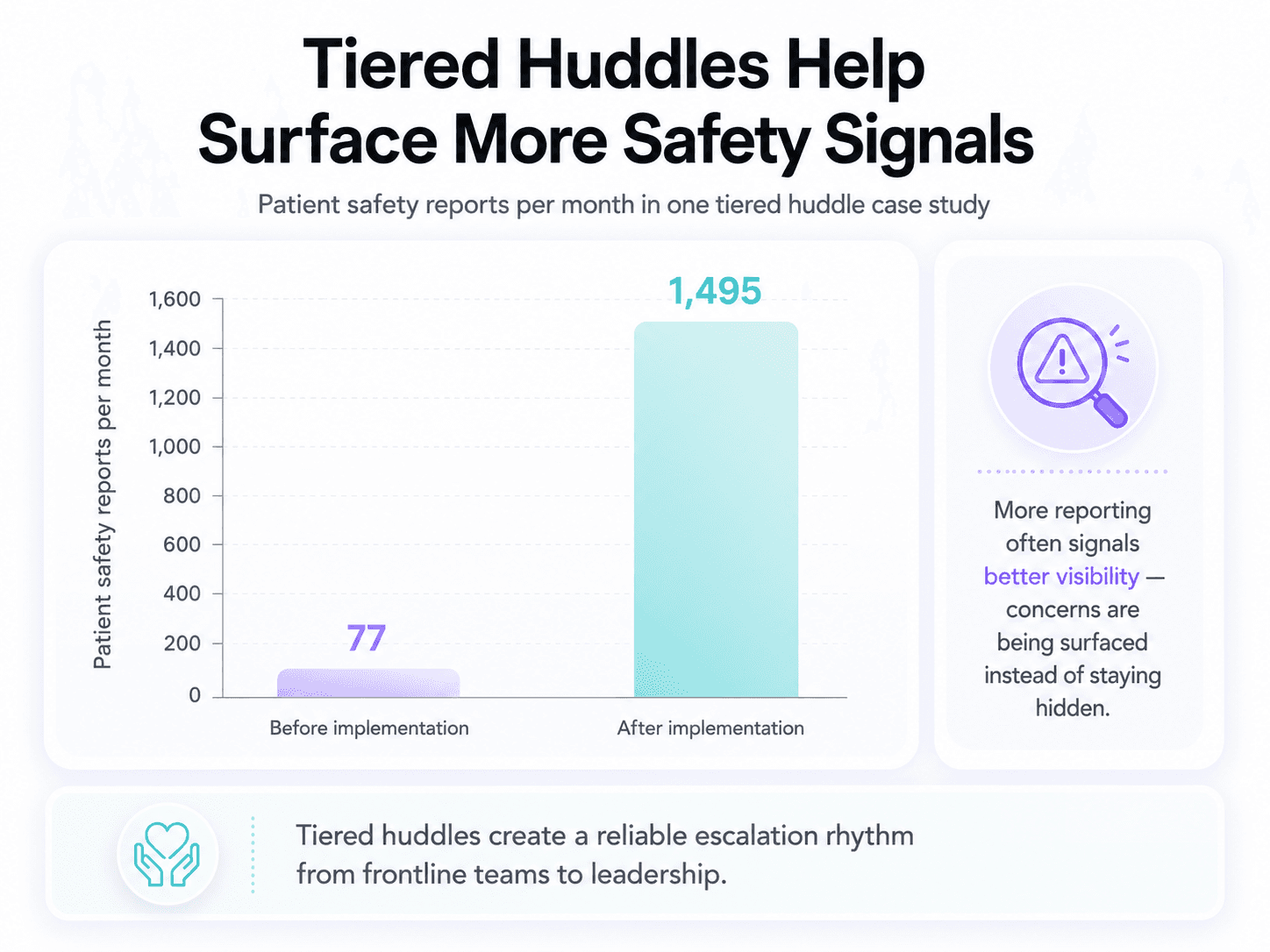
The impact can be significant. In one tiered huddle case study, patient safety reports increased from an average of 77 per month before implementation to 1,495 per month after implementation. A separate Joint Commission Journal study found that system-level tiered huddles led to a significant immediate increase in patient safety event reporting, including near misses and unsafe conditions.
This matters because many organizations already have plenty of signals. The problem is that signals do not always become action. A staff member notices a change. A nurse hears a concern. A family member mentions something in passing. A resident behaves differently than usual. Without a reliable escalation rhythm, those details can disappear into hallway conversations, shift changes, or informal memory.
That is why huddles and handoffs should be treated as one continuity system. Hospitals have also treated handoffs as a safety issue, not a communication preference. The most cited example is I-PASS, a structured handoff bundle that includes a mnemonic for oral and written sign-outs, training, observation, coaching, and sustainability mechanisms. Across nine pediatric residency programs, implementation of the I-PASS bundle was associated with a 23% relative reduction in preventable adverse events.
Senior living does not need to copy I-PASS exactly, but it can borrow the principle: handoffs should have a repeatable structure, not depend on whoever happens to be giving the update. In many communities, the daily standup, shift change, care coordination discussion, and “who needs extra eyes today?” conversation are already solving the same problem: making sure the right people know what changed, what matters, and what happens next.
What senior living can borrow: a short, repeatable operating rhythm for surfacing changes, escalating risks, assigning owners, and protecting continuity across shifts.
1) Shared, real-time situational awareness
Hospitals learned that binders, scattered notes, and person-to-person updates do not scale when care is fast-moving and cross-functional. Many emergency departments replaced manual dry-erase boards with electronic whiteboards because teams needed one shared picture of what was happening in real time. A systematic review of electronic whiteboards in emergency medicine found that they can influence ED work practices and information accuracy, while also emphasizing that outcomes depend on display design, workflow fit, and integration with other clinical IT systems.
At the enterprise level, many hospitals have gone further and built capacity command centers: colocated teams that use real-time data to manage patient flow across beds, transfers, and throughput. The Joint Commission Journal describes these command centers as an emerging response to safety and financial pressures created by ED boarding and constrained inpatient capacity, built around aggregated real-time data and cross-team coordination. In its benchmarking survey, 25 of 31 responding health systems were already operating a capacity command center; reducing ED boarding was the most common motivation, cited by 24 of those 25. The same survey found that 18 command centers tracked financial ROI, and all 18 reported positive ROI.
There is an important caution here: visibility tools only work when the surrounding workflow and data are solid. A status board is not a strategy. It works when it becomes the default place teams look, update, and act.
What senior living can borrow: one shared operational view for the shift, so teams can quickly see what changed, what needs action, and who owns it.
2) Structured huddles and handoffs that turn signals into action
Hospitals also learned that visibility without escalation just creates noise. One of the most transferable practices is the Tiered Huddle System: short, structured huddles where issues move from frontline teams to leadership with clear ownership and follow-through. “Tiered” means that concerns do not stay trapped at the level where they were first noticed. Frontline teams surface risks and blockers, department leaders resolve what they can, and unresolved or higher-risk issues move up to senior leaders with an owner and next step.
The impact can be significant. In one tiered huddle case study, patient safety reports increased from an average of 77 per month before implementation to 1,495 per month after implementation. A separate Joint Commission Journal study found that system-level tiered huddles led to a significant immediate increase in patient safety event reporting, including near misses and unsafe conditions.
This matters because many organizations already have plenty of signals. The problem is that signals do not always become action. A staff member notices a change. A nurse hears a concern. A family member mentions something in passing. A resident behaves differently than usual. Without a reliable escalation rhythm, those details can disappear into hallway conversations, shift changes, or informal memory.
That is why huddles and handoffs should be treated as one continuity system. Hospitals have also treated handoffs as a safety issue, not a communication preference. The most cited example is I-PASS, a structured handoff bundle that includes a mnemonic for oral and written sign-outs, training, observation, coaching, and sustainability mechanisms. Across nine pediatric residency programs, implementation of the I-PASS bundle was associated with a 23% relative reduction in preventable adverse events.
Senior living does not need to copy I-PASS exactly, but it can borrow the principle: handoffs should have a repeatable structure, not depend on whoever happens to be giving the update. In many communities, the daily standup, shift change, care coordination discussion, and “who needs extra eyes today?” conversation are already solving the same problem: making sure the right people know what changed, what matters, and what happens next.
What senior living can borrow: a short, repeatable operating rhythm for surfacing changes, escalating risks, assigning owners, and protecting continuity across shifts.
What this means for senior living
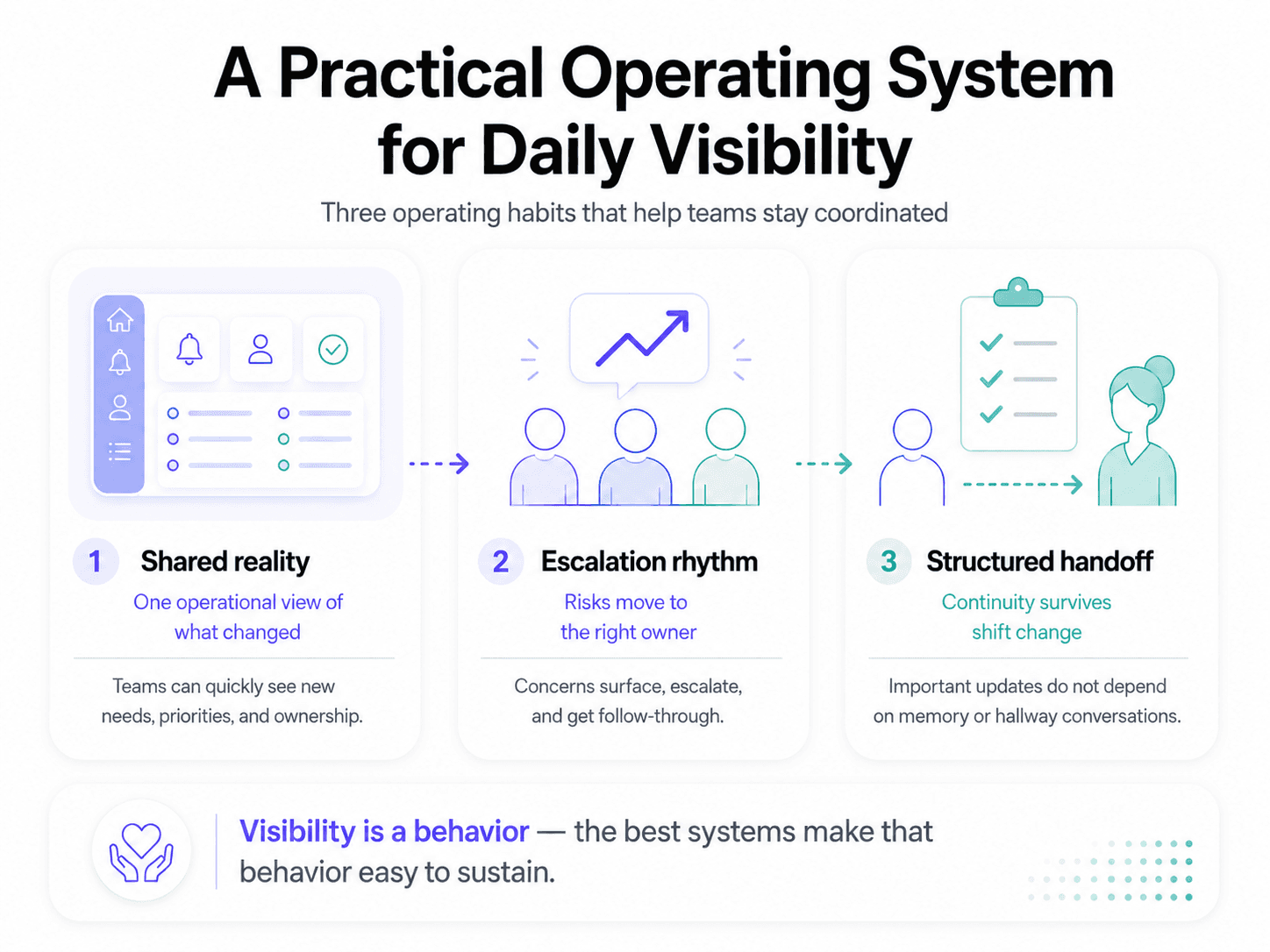
If healthcare’s last decade taught anything, it is that software alone does not create visibility. Visibility is a behavior, and the best systems make that behavior easy enough to sustain.
The common thread across these lessons is operational design:
A shared picture of reality works when it is integrated into the day, not bolted on.
Escalation has to be systematic, or signals die in hallway conversations.
Handoffs need structure, not goodwill.
Senior living does not need to repeat healthcare’s most painful lesson: documentation can balloon while real coordination stays fragile. The opportunity is to build a practical operating system for daily visibility: shared situational awareness, predictable escalation, and structured handoffs that help teams act on what changed.
That is how communities get calmer operations, fewer surprises, and a shared reality every team can act on.
If healthcare’s last decade taught anything, it is that software alone does not create visibility. Visibility is a behavior, and the best systems make that behavior easy enough to sustain.
The common thread across these lessons is operational design:
A shared picture of reality works when it is integrated into the day, not bolted on.
Escalation has to be systematic, or signals die in hallway conversations.
Handoffs need structure, not goodwill.
Senior living does not need to repeat healthcare’s most painful lesson: documentation can balloon while real coordination stays fragile. The opportunity is to build a practical operating system for daily visibility: shared situational awareness, predictable escalation, and structured handoffs that help teams act on what changed.
That is how communities get calmer operations, fewer surprises, and a shared reality every team can act on.